
AI and the Inverted Funnel
Personal Digital Wallets and Agent Commerce Will Turn Marketing Inside Out
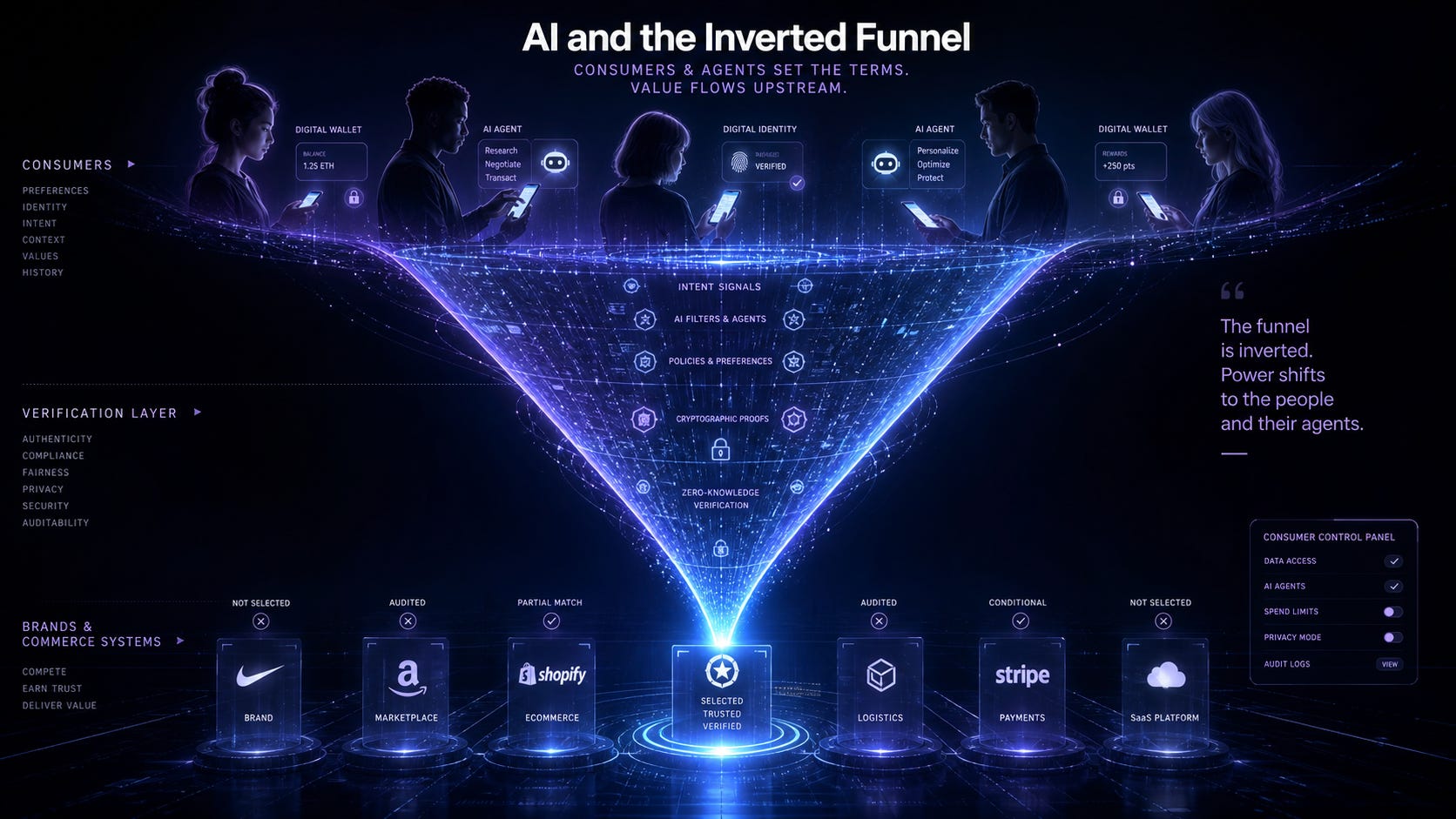
Personal Digital Wallets and Agentic Commerce Will Turn Marketing Inside Out.
By Michael Cooper | UNCX & The Age of Entanglement.
The Age of Entanglement is now, when identity, technology, institutions, and interfaces are no longer separate from each other.
These elements now shape each other as things happen, making it hard to tell where choice, delegation, and influence begin or end. We’re not just using systems now; we’re living in the environments they help create, and where systems affect us in return.
This week I’m looking at one of the clearest expressions of that shift: the rise of personal digital wallets and agentic commerce, and what that means for power, privacy, and the future of marketing.
If you’ve been reading my newsletter for a while, you’ll recognise a broader pattern. In The Age of Entanglement, I argue that the boundaries between “us” and “our tools” are dissolving. In The Human Side of AI Disruption, my emphasis shifts to how intelligent systems detect, amplify, and respond to the different modes we inhabit.
In AI Browser Wars: Your Customer Now Brings an Agent, I explain how the interface itself has started to move.
And in What Happens When Your Agent Makes the Mistakes, the promise of delegated intelligence comes with a bigger question: who is accountable when systems act on our behalf, but get it wrong?
This edition sits at the intersection of all four.
It focuses on six connected dynamics:
Fluid Identity & Consumorphosis: How identity wallets give technical form to contextual, mode-based selves.
Intelligent Interfaces: How personal AI agents become operational intermediaries between people and markets.
Human Autonomy & Agency: How consumers gain new tools to constrain, delegate, and govern machine action.
Value Creation vs Value Extraction: How surveillance-heavy commercial models begin to lose their default advantage.
Choice & Decision Choreography: How wallets and agents turn decisions into programmable conditions rather than reactive clicks.
Momentary Relevance vs Loyalty: How static customer profiles give way to temporary, context-dependent brand access.
State of Play: The Infrastructure Shift
The infrastructure for wallet-mediated commerce is maturing quickly, and 2026 increasingly looks like a moment, as it starts to move to practical relevance.
Standards for identity presentation, credential verification, and selective disclosure are beginning to converge. What looked speculative only a short time ago is now appearing in onboarding flows, travel, payments, telecommunications, and access control.
Wallets, in other words, are no longer just places to store payment cards or crypto assets. They are becoming operating environments for identity, verification, permission, and action.
That matters because digital commerce has rested on one unspoken asymmetry: brands know more about us as consumers than we as consumers know about brands.
To buy a ticket, order a shirt, or book a room, we routinely surrender personal data. We create accounts, hand over birth dates, home addresses, phone numbers, payment details, and long-term permission to remember us.
Big tech and large-scale retailers don’t win just by building better products; they win by turning convenience into a moat.
Saved cards, saved addresses, login state, and persistent behavioural memory made leaving feel inconvenient enough to stay.
Marketing in this context is fundamentally extractive. Brands tracked, profiled, segmented, scored, and targeted passive consumers.
And that logic is beginning to be broken.
The convergence of personal wallets and agentic AI doesn’t end marketing, but it does begin to invert its assumptions. As we gain the ability to verify less, disclose selectively, and delegate action through software acting in our interest, the brand is no longer the only party doing the sorting. Increasingly, we as consumers - and our algorithmic proxy - can audit, filter, and govern the brand.
1. Selective Disclosure: From Data Exhaust to Data Restraint
The technical cornerstone of this shift is selective disclosure.
Historically, proving one thing about yourself often meant exposing far more than the transaction needed. To verify, you might reveal your full legal identity. To prove you could pay, you might hand over enough data to create a durable commercial memory.
For brands, it became the raw material for CRM expansion, behavioural targeting, and surveillance-heavy growth.
Selective disclosure changes the structure of the exchange.
With a cryptographic wallet, we can prove a claim without revealing the full identity beneath it. We can demonstrate that we’re over a legal threshold, live in a region, or hold valid payment credentials without disclosing our exact birth date, address, or persistent account history.
That’s more than a privacy upgrade. It is a strategic inversion.
When we can transact without routinely leaving behind excessive personal data, the static CRM profile begins to lose its position as the primary engine of commercial relevance. Surveillance loyalty weakens when memory is no longer automatically captured.
Brands can no longer assume that accumulated data guarantees future access. Crucially, they will have to become relevant in the moment, under the conditions the moment permits.
This is a place where the argument connects directly back to my article The Age of Entanglement. We’re no longer simply an extractable user at the edge of a system. The system is now closer to the Self, and the Self has new tools for limiting what the system gets to know.
2. Programmable Delegation: The Wallet as Guardrail
And as we delegate more to AI agents, a new question pops up: under whose rules does the agent act?
An agent is only as safe as the constraints around it. That’s why the wallet matters. It’s not just a storage layer for identity. It’s a boundary-setting mechanism for machine action.
The wallet becomes our cryptographic guardrail.
This is where the argument connects to The Human Side of AI Disruption.
AI doesn’t merely personalise; it detects and amplifies human modes. It responds to urgency, hesitation, aspiration, and context.
But once that detection becomes actionable, we need a way to govern what the system can do with what it has inferred about us.
We could set rules such as:
My shopping agent may spend up to $150 on running shoes, but only with merchants that request no unnecessary data.
Reorder household essentials automatically, but reject vendors using manipulative renewal patterns or surge pricing.
Complete a booking only if cancellation, warranty, and refund terms are machine-readable and verifiable.
In this environment, the wallet is not simply presenting credentials. It is carrying permissions, thresholds, refusals, and conditional instructions.
When the agent enters the market on our behalf, it does not act freely. It acts under our policy.
If a merchant asks for excessive data, inserts hidden fees, or deploys coercive design, the wallet can refuse the exchange before we’re drawn into the trap. It doesn’t eliminate manipulation, but it relocates resistance from the interface alone to the transaction logic itself.
The wallet does not simply store identity. It becomes a site where identity, permission, and action converge.
3. The Collapse of the Friction Moat
Many large e-commerce players dominate because they control convenience.
People bought from Amazon and other major retailers not only because they trust them, but because these platforms already hold payment details, shipping addresses, and one-click state. Trying a smaller seller is friction - often starting from zero, creating another account, entering card details again, and exposing personal info to another database breach.
That friction isn’t a side effect. It’s an advantage.
And wallets and interoperable commerce protocols weaken that advantage. If payment authorisation, shipping credentials, and identity proofs can move with the consumer, then low-friction checkout no longer belongs exclusively to the largest platforms.
A smaller merchant can become as easy to transact with as an incumbent giant, provided it can meet the interoperability and trust requirements.
That doesn’t erase scale, logistics, or brand familiarity. But it does erase one of the deepest structural advantages of platform capitalism: the ability to trap convenience inside a proprietary environment.
This is where the logic of AI Browser Wars: Your Customer Now Brings an Agent becomes especially relevant. We no longer arrive only through a browser tab or branded app. Increasingly, we arrive through a software intermediary that carries context, preferences, permissions, and decision criteria with it.
The interface has moved.
And once the interface moves, so does the balance of power.
4. Wallet-Backed Identity Fluidity: From Profiles to Modes
This technological inversion mirrors a psychological reality that traditional marketing has repeatedly failed to understand: people are not static demographic blocks. They are fluid, contextual, and situational. This is the logic of Consumorphosis.
Brands prefer the fiction of stable identity because it makes targeting easier. It is far easier to market to a persistent profile than to a person who shifts between urgency, curiosity, caution, ambition, and performance.
But most consumer life is not stable. It’s modal.
We don’t want lifelong relationships with every brand we touch. Most of the time, we’re not entering brand marriages. We are entering temporary arrangements: situationships shaped by need, mood, context, timing, and consequence.
Digital wallets give that reality a technical form.
They allow us to reveal different proofs, permissions, and fragments of identity depending on the mode we’re in:
Rush Mode: High urgency, task-driven, low tolerance. The goal is speed, privacy, and minimum exposure.
Explore Mode: Low urgency, open curiosity. We can share temporary signals to support discovery without consenting to permanent tracking.
Commit Mode: High stakes, trust-sensitive. Stronger credentials are revealed to support consequential decisions where assurance matters.
Express Mode: Outward-facing and performative. Memberships, affiliations, or symbolic credentials are presented to signal belonging or alignment.
This is also where The Human Side of AI Disruption plays out. Intelligent systems do not just respond to declared preferences. They increasingly detect the mode we are in and adapt around it. Wallets extend that dynamic by allowing the consumer to govern what that mode reveals and authorises.
The result is not just personalisation. It’s controlled situational disclosure.
Instead of one persistent brand-owned profile trying to explain the whole person, different moments can carry different proofs. The brand does not define the consumer. The consumer defines the terms under which a version of the self becomes visible.
5. The Reverse of Marketing: When the Consumer Audits the Brand
When identity sits in a personal wallet, and action is delegated through agents, the direction of persuasion begins to change.
For decades, marketing asked: how can the brand find, track, and influence the consumer?
In a wallet-mediated environment, a different question emerges: why should the consumer’s software allow this brand to enter the transaction at all?
That’s the inversion at the heart of this story.
The brand is no longer speaking only to a human subject. It is increasingly being assessed by a human-machine arrangement that can screen for relevance, trustworthiness, data discipline, and transactional clarity before a person even arrives at the final decision point.
That changes the strategic requirements for brand and experience leaders.
This is not the disappearance of marketing. It is marketing entering a permission regime.
The brands that succeed will not simply be the loudest, the most optimised, or the most extractive. They will be the ones that are easier to verify, easier to trust, easier to parse, and easier to choose within an environment where consumer-side intelligence has become structurally stronger.
They will need to be cryptographically trustworthy, operationally legible, and culturally distinct.
That’s a different kind of competition.
It also links directly to the broader argument in AI Browser Wars: Your Customer Now Brings an Agent: brands are no longer competing only for human attention. They are competing for admission into a mediated decision layer.
6. The Harder Edge: When Delegation Fails
There is, however, a risk in telling this story too cleanly.
Wallets and agents can strengthen consumer leverage, but they also introduce new ambiguity. Once software begins acting on our behalf, mistakes become harder to locate. Was the error made by the agent, the merchant, the wallet policy, the data source, or the logic connecting them?
This is the tension explored in What Happens When Your Agent Makes the Mistakes. Delegated intelligence does not just create efficiency. It creates new accountability gaps.
The agent may follow the wrong source of truth. Two different systems may act on outdated assumptions. A wallet may enforce a rule that made sense in one context but fails in another. The problem is whether anyone can explain, audit, and recover the failure when it doesn’t.
So human autonomy shouldn’t be understood as simple automation plus convenience.
Real autonomy in an entangled environment depends on governed delegation. It depends on the ability to set conditions, trace decisions, override outcomes, and repair mistakes. Otherwise, what looks like empowerment quickly becomes a subtler form of dependence.
The consumer may hold the wallet. But unless the surrounding system remains accountable, the wallet can become just another beautifully designed interface for losing control.
The Strategic Takeaway
What personal wallets and agentic commerce threaten is not persuasion itself, but the business model that treated asymmetry as a permanent advantage.
For years, brands assumed they could know more, retain more, remember more, and therefore control more. But if identity becomes portable, disclosure becomes selective, and delegation becomes programmable, that advantage begins to erode.
The funnel doesn’t disappear. It flips.
Brands are no longer simply pulling consumers through an engineered journey of capture, nudging, and conversion. Increasingly, consumers and their agents will pull brands through a new filter: one shaped by privacy thresholds, machine readability, interoperability, ethical clarity, and situational fit.
Future commerce is not frictionless. It’s conditional.
And in that conditional world, brands are no longer guaranteed access to attention, data, or loyalty. They must qualify for entry into the moment.
For my regular readers, that’s the deeper continuity here. The Age of Entanglement isn’t just about smarter systems.
It’s about what happens when identity, interfaces, incentives, and institutions begin reshaping one another in real time.
Wallets and agentic commerce are not a side story. They are one of the clearest places where that entanglement becomes commercially visible.
They show, in practical terms, what it means when the self becomes infrastructural — and when the infrastructure starts negotiating back.
I hope you enjoy this article. If you’d like to talk more about these ideas, please feel free to reach out.
I’m also opening up spots for conferences, in-house presentations, and in-depth one-on-one calls, starting in September. DM me.
Thanks for reading UNCX | The Age of Entanglement.
Subscribe for free - you get all new posts and support my work.