
AI and Your Two Selves
Be more than your machine-readable traces

We’re living through a quiet revolution.
Artificial intelligence is now part of our everyday environment, having matured from being a set of tools we use sometimes to something quietly shaping what we see, and how we make decisions.
And increasingly, who we think we are.
Search engines, recommendation feeds, biometric checks, and generative platforms are more than just services. They’re part of a bigger change, now shaping how we are seen and how we act.
As these systems sort and interpret us, our sense of self is more and more defined by what technology can see, and by what we use.
This is just one entrance into what I call the Age of Entanglement. The lines between people and systems are blurring in ways we are only starting to understand.
The legible self in an entangled world.
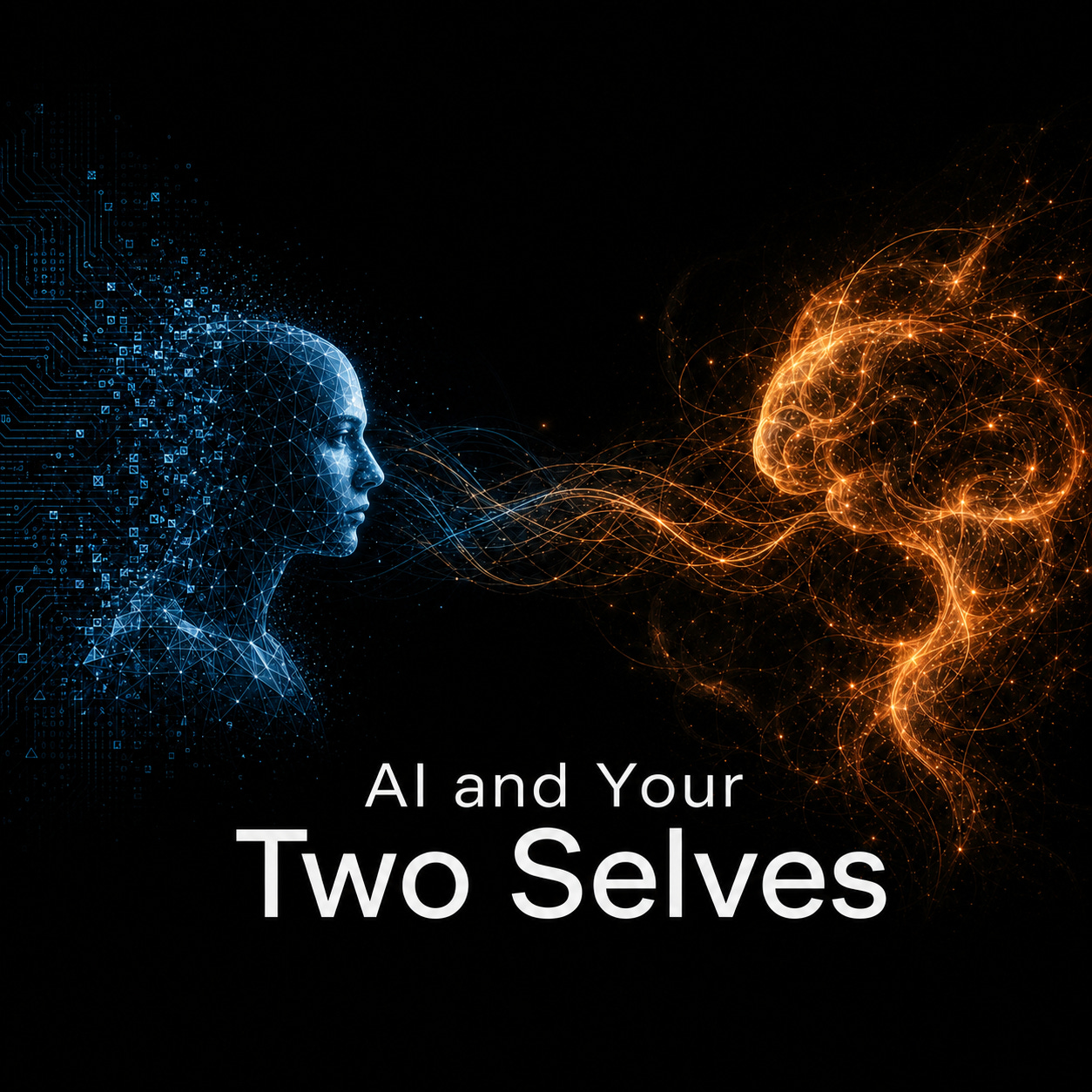
To live in this moment is to live as two selves at once.
There’s the you that feels, remembers, hesitates, changes your mind, daydreams, and contradicts yourself.
And then there’s the you that our systems see.
That system self is (what I call) the legible self. It’s the version of you made from anything that can be captured, tracked, modelled, and used - like your click patterns, location data, biometrics, purchase history, watch time, prompts, preferences, and social signals.
It’s measurable.
It’s optimisable.
It’s profitable.
And it’s incomplete.
Every new interface that personalises something for you is almost always working with your legible self. Every message, such as “because you watched,” “recommended for you,” or “people like you also bought” shows how the system predicts a version of you it can understand.
In our entangled world, your legible self isn’t separate from you. It is part of your daily life and shapes how brands, institutions, and platforms interact with you.
But it isn’t the whole of you.
The wild self
There is also the part of you that remains harder to read.
The you-part that doesn’t fit neatly into models.
It’s your wild self.
This wild self is the part of being human that can’t be easily captured. It includes intuition, imagination, symbolic meaning, contradiction, longing, spiritual experience, irrational courage, and the ability to change in ways no past pattern could predict.
It’s the part of you that surprises even you.
This matters. Because if systems focus on the legible self, the wild self is where your freedom exists.
Not freedom as choosing from a menu of pre-set options.
But freedom to sense there might be another option altogether.
Freedom as ambiguity.
Freedom as improvisation.
Freedom as becoming.
I’m not anti-technology. I just want to remind you that not everything valuable about you becomes more valuable when it’s measured.
Entanglement is the condition.
So I keep returning to the Age of Entanglement as the frame.
We no longer live in a world with clear lines between people and systems, or between online and offline, or between decisions and the environment.
We live through interfaces.
The feed, the dashboard, the checkout flow, the search result, the chatbot, the recommendation carousel, the loyalty app, the “smart” assistant.
These aren’t neutral surfaces. They’re active environments that shape what appears, what feels relevant, what is hidden, and what becomes possible.
This sits in the centre of my thinking on Intelligent Interfaces.
An Intelligent Interface is not just a user experience stuck onto a system. It’s where systems read us, sort us, and guide us in real time. This is where the legible self turns into action.
That action might be a recommendation.
It might be a ranking.
It might be friction.
It might be access.
It might be exclusion.
And because these interface environments are adaptive, they do more than respond to us.
They participate in shaping us.
From choice to pre-selection.
One of the biggest shifts is that systems have gone beyond simply supporting decision-making.
Increasingly, they act before the decision is made.
They pre-sort options.
They rank outcomes.
They filter possibilities.
They make some things easier and make other things harder.
This is usually subtle.
Which is why it matters.
You may feel like you are making a choice, but the options have already been shaped before you even see them.
Take something as ordinary as applying for a job.
You update your CV. Write a cover letter. Decide where to apply.
It feels like a human process.
But before anyone looks at your application, a system has likely already reviewed your experience, scored your fit, compared your words to those of ‘successful candidates,’ and filtered you based on that.
Sometimes your application never reaches a human being at all.
Not because somebody consciously rejected you.
But because your legible self was filtered out upstream.
And what you experience is not a visible act of exclusion.
You get no response, or you are left with a vague feeling that maybe you just were not the right fit.
The same patterns appear in credit scoring, insurance pricing, content recommendations, pricing models, and customer service flows.
The system acts on the legible self first.
You feel the consequences later.
This is the subtle shift from helping people make decisions to shaping what choices are available in the first place.
Why perception matters more than choice.
We talk about agency as if it begins at the point of decision.
But in an entangled environment, agency starts earlier than that.
It starts in perception.
In what is presented to you.
In what gets framed as relevant.
In what seems normal.
In what disappears before you ever knew it was an option.
This is why Intelligent Interfaces matter so much.
They don’t just mediate transactions.
They shape the perceptual field in which your choices are made.
A recommendation system does more than show you content. It sets the boundaries of what you see in your culture.
A commerce interface doesn’t just present products. It frames what kind of consumer you appear to be.
A hiring platform does more than process candidates. It limits which versions of you are visible enough to move forward.
Once you begin to see this, you won’t easily unsee it. You’ll move beyond asking whether technology helps us or harms us and instead see the difference between a choice you make and a path that was subtly laid out in advance of you.
The consumer and brand entanglement.
It’s also why brand strategy changes in this Age of Entanglement.
Brands used to operate mainly at the level of story, identity, positioning, and perception. They influenced us through their messages and meanings.
Now, brands work more and more inside systems that control what we see and what choices we have, like recommendations, ranking logic, personalised offers, search results, behavioural nudges, or eligibility models.
Inside recommendations.
Inside ranking logic.
Inside personalised offers.
Inside search results.
Inside behavioural nudges.
Inside eligibility models.
A brand is no longer just what it says.
It is also how it appears, when it appears, to whom it appears, and under what conditions.
For consumers, this means that brand choices are shaped more by how interfaces work than by personal preference. The shelf is now always changing. The way to buy something adapts. The moment you consider a brand, it’s no longer neutral.
For brands, this means they’re no longer only trying to persuade. They are participating in environments that shape identity and autonomy.
That’s a change in the ethical and strategic brief.
It moves the question from ‘how do we become more relevant?’ to ‘what kind of perceptual environment are we helping create? One that narrows people into predictable patterns? Or one that leaves room for surprise, change, and human agency?’
To address this, the core problem must be clear.
So this is the core problem as I see it.
In our entangled future, systems focus more on the legible self because it is easier for technology to process, predict, and make money from. My main point is that when systems put the legible self first, our richer and less predictable wild self can be pushed aside, which threatens real autonomy.
But when the legible self becomes the dominant version of the person, the wild self begins to shrink.
And when the wild self shrinks, autonomy weakens.
Not because someone has taken freedom away in an obvious sense.
But the things that make freedom possible, like ambiguity, inner life, imagination, reflection, unstructured time, and symbolic meaning, get pushed out by constant optimisation.
Our challenge isn’t humans versus machines.
At its core, the challenge is whether people can stay more than what systems can read, and whether we can keep our autonomy in a world built around what technology can measure. This is the heart of my argument.
A Way Forward: self-sovereignty in the entangled age
The answer is not to reject systems, romanticise a pre-digital past, or pretend we can somehow stand outside all this.
We are entangled. This is our permanent condition now.
The answer is to become more aware while living in it.
That means, first, learning to recognise and shape your data shadow.
To understand that systems are acting on a version of you all the time.
See your data shadow as just one part of who you are, not your whole identity.
And it means, second, deliberately protecting and cultivating the wild self.
Making space for the parts of life that do not reduce well.
Time without prompts.
Attention without interruption.
Curiosity without optimisation.
Meaning without metrics.
Relationships are not entirely mediated through systems.
This is the essence of self-sovereignty today.
Not just in privacy settings or compliance rights.
It means having control over your attention, your environment, how you find meaning, and your ability to sense more than what is shown to you.
Our entangled future
The Age of Entanglement is not just a technological phase.
It is a new way of being human.
We are living as both legible and wild selves, inside systems designed mostly for the legible parts.
The future will be shaped by how we handle that tension.
As individuals, the challenge is to remain more than our readable traces.
As brands, the challenge is to stop treating people as only what can be predicted.
For designers and leaders, the challenge is to create Intelligent Interfaces that don’t just manage behaviour, but also leave space for people to be themselves.
Because that is what’s really at stake.
Not will systems get smarter.
But whether we remember that a person is always more than what a system can see or measure.
And if, in our entangled age, we design accordingly.
Want to read more?
The Surface Has Moved. So Has The Self.
Or, simply subscribe to my free newsletter.
A very interesting read. With some good advice. Thank You.